
When Memory Became a Luxury
A quiet corporate decision in December told us the next three years before anyone was ready to listen


Please before diving in, read this disclaimer.
In December 2025, one of the three companies that makes almost all of the world’s memory chips made a decision that should have been front page news and instead passed almost unnoticed.
Micron announced it was killing Crucial, the retail brand it had sold memory modules under for twenty-nine years. The white and black boxes you would find in any electronics store, the modules a teenager buys to breathe a few more years into an aging gaming PC, gone by February 2026. The reason given was almost brutal in its honesty lol: the company wanted to redirect those production lines toward its larger strategic customers in faster growing segments.
Read that again, because we forgot it but it is the whole story compressed into a single sentence. A memory maker looked at the ordinary person buying a stick of RAM, looked at the hyperscaler buying tens of thousands of AI accelerators, and decided the ordinary person was no longer worth the silicon.
I have spent a good part of the last two weeks sitting with this, more coffee than I would like to admit going cold next to me, because the more I looked the more I became convinced that this was one of those small signals that mark the beginning of something large.
Disclaimer : I am not trying to predict the next cycle or regime change. And like most regime changes, the interesting money is not in the obvious victims or the obvious winners. It is in the second order effect, in the companies rebuilding themselves around a constraint that most of the market has not yet, priced.
The shortage is real, and it is structural
Let me give you the numbers first, because they frame everything that follows.
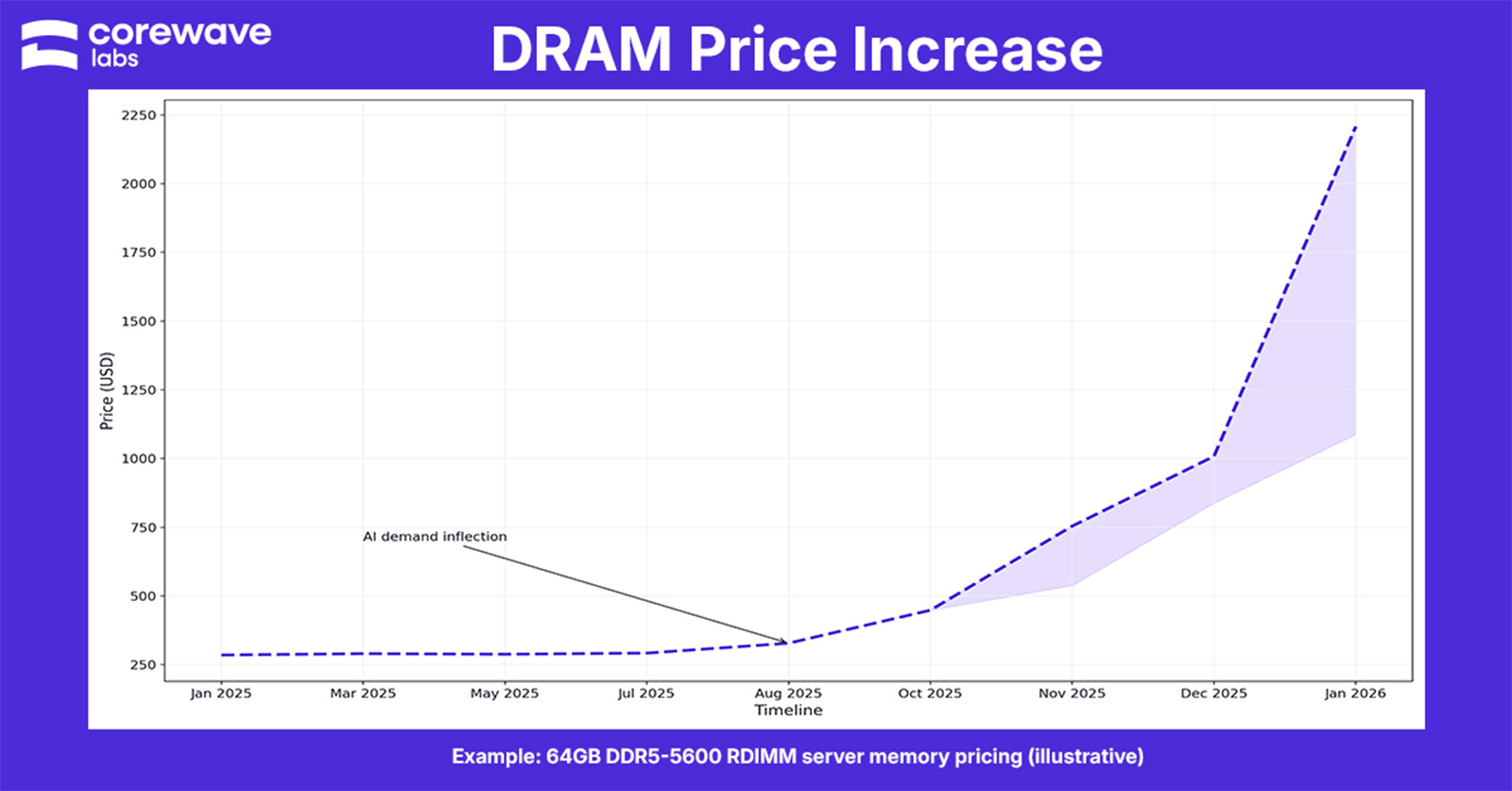
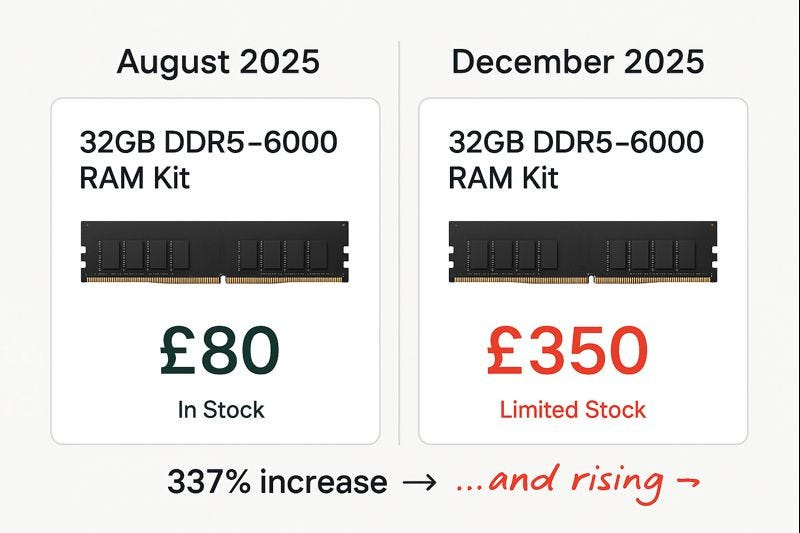
Memory prices did not drift higher, as we say, they completely broke.
DRAM prices rose roughly 50% across 2025, with another thirty to 40% expected in the first quarter of 2026 alone. Even more as I write these lines.
Counterpoint Research has said that the DDR5 modules that sit inside enterprise servers could cost twice as much by the end of 2026 as they did at the start of 2025. The spot price of a single memory chip went from under five dollars on average in 2024 to nearly forty dollars in early 2026. Server memory lead times stretched from twenty-five weeks to forty-five weeks. Suppliers started demanding prepayment from new customers, which quietly strangles any business too small to wire cash months ahead of delivery.
The three companies that make this stuff, Samsung, SK Hynix, and Micron, each crossed a trillion dollars in market value in May 2026. A memory ETF launched in April gathered five billion dollars in seven weeks, one of the fastest launches in the history of the product. When money piles into a theme that fast, my instinct is caution rather than enthusiasm, because it usually means the easy part of the trade is already behind us.
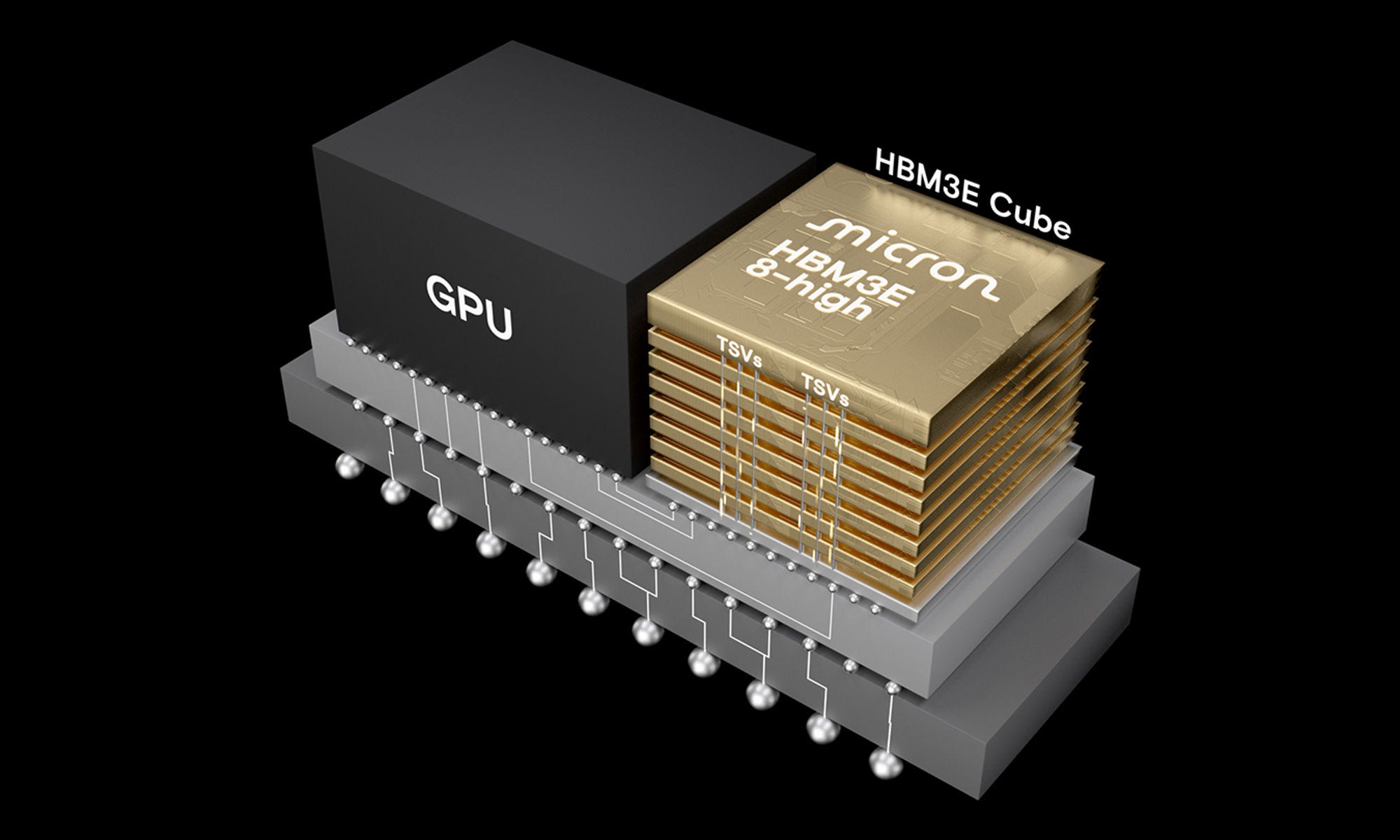
The chipmakers have deliberately shifted their factory capacity toward the high bandwidth memory that feeds AI accelerators, because the margins there are extraordinary and the contracts are locked years in advance.
SK Hynix has sold out its entire 2026 production of that memory. Every wafer that goes to an AI chip is a wafer that does not become a stick of RAM for a laptop or a server. And you cannot simply build more, because a new memory fab takes four to five years to come online.
The chairman of SK Group said in March that the shortage could persist until 2030, with a shortfall north of 20%. When customers start offering to fund their own suppliers’ factories just to secure allocation, you are no longer looking at a passing squeeze.

Elon Musk has talked about hitting a chip wall. Demis Hassabis, Google Deepmind, called memory a choke point for the entire industry. Those are not the words men like him use about a problem that clears in two quarters…
The part nobody is pricing
Okay, now that everyone understands the headline: phones get more expensive, gaming rigs get more expensive, the memory makers print money.
That part is in the open.
What fewer people have worked through is what happens to the companies that consume memory for a living. Every software business that stores, searches, or analyzes large volumes of data has built its architecture on an assumption that held true for thirty years, which is that memory was so cheap it was effectively free. You loaded everything into fast memory and you processed it there, because why would you not.
RAM cost nothing.
Modern AI applications lean on a particular kind of workload that traditionally has to live entirely in memory to be fast. The more data a company wants its AI to reason over, the more of this expensive memory it has to provision. So you have a brutal scissor closing. On one blade, AI is pushing companies to keep ever larger mountains of data in fast memory. On the other, that memory is becoming the scarcest and most expensive resource in the building.
A CFO who six months ago barely thought about infrastructure cost is now watching it eat the margin.
When a constraint like this appears, an industry adapts in one of two ways.
Either it pays the toll, which the giants can afford and everyone else cannot. Either it finds a way to do the same work while needing far less of the scarce thing. History is fairly clear about which approach creates more value over time, and it is rarely the one that simply pays up.
So the question that has occupied me is not which memory maker to buy.
That trade is crowded and late (even if it can still go up?). The question is which company has quietly rebuilt its core technology so that its customers can keep doing the expensive thing without paying the expensive price.
Because that company gets more valuable precisely as the shortage deepens, and right now almost nobody is looking at it through that lens.
The questions that make you understand
I will hand you the questions that pulled me toward a single name, and I will leave them unanswered here, because the answers are the work.
Which company has spent the last year reengineering its product specifically so that the most memory hungry AI workload no longer needs to sit in expensive memory at all?
Why would a software business deliberately move its flagship capability off memory and onto cheap disk, and what does that tell you about where it thinks the world is going?
How do you value a business whose stock has fallen for two years while its actual product became more relevant than it has ever been?
What does it mean when a company’s most important technical breakthrough cuts the memory cost of its hardest workload by more than 90%, and the market barely reacts?
Why is one of the most widely deployed data platforms in the world, used by more than half of the Fortune 500, trading near the lowest valuation multiples of its entire public life?
And the uncomfortable one: what if the very efficiency that makes this company a winner also undermines the part of its business that pays the most?
That last question is where most analysts I read stop, but it is exactly where the interesting part begins… so I made the job!
Last time I called this kind of play, it went +140% since publication. Not a flex, but just to say: it might work just like this for what comes next. Because it’s the same mechanism.
Here’s the article I am referring to:

By the way I think it’s not over, there are still room to growth.
Okay now, let’s go.
