
Never Buying Salesforce?
I spent three hours with someone at Salesforce and asked them what will they about AI, their answer will surprise you.

Please before diving in, read this disclaimer.
Hello everyone, a quick note following this Substack Note I posted 2 days ago.
As you know it if you followed me for quite some time now, I like sometimes to give my opinion on stocks:
Today I focus on a specific software as the sector is going through a bloodbath.
The Issue
Indeed, as part of my study (you guys know I am still a student, right?) I had the chance to spend 3 hours with a Salesforce representative. And of course with what is happening with software, I stopped writing (because yes I write articles during classes (and still have good grades don’t worry)), started actually listening (which occur from time to time) and started challenge the person.
I took note of what they say, so this article is as precise as it can possibly be.
They started with a presentation of Salesforce, and they insisted: an old, presentation of Salesforce. Salesforce is a customer centric software, and the only word they had in mouth were ‘customer’ ‘customer centric’ ‘customer driven’ and so on…
Bla-bla-bla.
Really interesting, if the year is 2010. I started to raise my hand, prepared in my head the arguments I was about to use to destroy the thesis about their software. But then. - they continued: “And here’s the new presentation we use now”.
I shut the f*ck up and listened.
“At Salesforce, we help companies run customer-facing work in an AI-first world. […]. We unify customer data across sales, service, marketing, and commerce into a single trusted foundation. […] We turn that data into real execution through autonomous AI agents that can plan, decide, and act across workflows, with humans setting direction and staying in control. […]
We deliver enterprise-grade trust by design: permissions, governance, auditability, and security sit at the core of the platform so teams can deploy AI at scale with confidence.
At Salesforce, we connect data to action, accelerate execution, and help organizations serve customers faster, smarter, and at lower marginal cost… […]”
They presented us many use cases and how data was flowing across all department. It was really impressive actually. All departments provided with Salesforce suits allowed them to work, for real, smarter. Information (data) is central for them, and make sure that every piece is structured and used at its max potential.
And now the interesting part.
My questions and where is Salesforce now
I asked 4/5 questions.
First, are these use cases all operational now?
The answer was yes, and no. They said that many of the use cases they presented us are operational, but some of them are still marketing and some have not brought the results they expect, yet. What I am talking about?
AI lets Salesforce do one thing that used to be structurally hard: treat customer data as a shared, living asset across departments, instead of isolated tables owned by each team.
Concretely.
Sales, service, marketing, commerce keep their native schemas and tools. AI reconciles identities, timelines, and events into a single customer graph. One customer, one history, many uses.
The, rvery interaction updates the same object. A support ticket reshapes lead scoring. A payment delay changes churn risk. A campaign response alters service priority. No batch sync. No handoffs.
AI maps meaning, not just fields. “High-value account” in sales, “priority customer” in service, “VIP segment” in marketing become the same entity, interpreted differently depending on context which allow them to be more efficient in marketing campaigns for example.
Signals collected in one function generate actions in another, for instance service data feeds upsell timing, then marketing behavior informs renewal risk, commerce patterns influence account planning.
The system reasons across silos so one of my biggest fear was addressed.
Also,
AI respects permissions at the object, field, and action level. Finance can see revenue signal, support sees context, marketing sees consented attributes.
The same data backbone again and again, different lenses: true intelligence.
Net effect: data stops being “owned” by departments and starts behaving like infrastructure. Shared, updated in real time, and immediately actionable everywhere.
Everything, now powered by AI.
Second, they asked a question: who do you think is the biggest competition of Salesforce? People answered Hubspot and other CRM solutions.
I answered, Amazon and Google, for a second they looked perplexed and then I explain.
Second, will Google and Amazon disrupt Salesforce?
Sub question: What time do you have before Google starts to do a CRM?
Yes, it was clear for me: Google’s and Amazon’s solutions are deeply embedded in customers solutions (think about for a second of all the use cases Google or Amazon is doing for your company) and there is a time where they will both think that, they can aggregate quantity of proprietary data and Salesforce is just a use case they can address more efficiently.
(Note for the reader: after that, we used a limited version of Salesforce and it answered a part of my question).
They looked at me and said: yes for the thesis, but no for the pratical reality. Actually, Salesforce is working really closely with hyperscalers to power its existing solutions. Yes Google has the data is Gmail for isntance (that Salesforce use as integration - as many other examples) but Google is the way to communicate and the data is used by Salesforce. They both share the data, but the embedded intelligence is in Salesforce.
And to answer the second question, if they [Amazon, Google] would have wanted to do it [disrupt S.F.] they would have done it. The truth is, Salesforce played the long game in customer relationship, it doesn’t make any sens for them
So again, on a thesis is possible, but in reality, not reasonable.
We talked about embedded intelligence. Let’s push the agentic thesis.
Third, where is salesforce now in term of AI?
Sub question: with who do you work with? Do you cook you own models?
They work, with everyone, actually they allow their users to choose the models. They have integrations with Gemini, OpenAI and so on.
What works best for the customers: they go for it. And no, they don’t use their own trained model. It was on the table for a period of time, but they gave up on the idea.
Their bet: use the best models on private data of the customers. That is where the real value hides for them, and for me. Because at this point, once the agent is aware of the data and all the departments are connected, one prompt and you: create a new campaigns for dozens of different prospects, follow up emails, automatically report it, log the sequences, create the kpi and reporting… and so on.
So, what took an average of 3/4 days, now takes 5 minutes. And I am not even kidding on the time saved, as I work in the field.
To answer the first question: Salesforce is already at the agentic phase of AI with Einstein. As I said, they are here now it’s still not super developed for some of the remaining use cases (I have not more information, sorry).
What is the Strategy now?
First sub question: what do you think of the allegations saying Salesforce will be disrupted by Claude or other models?
Second sub question: is Salesforce pushing fancy AI agents use cases or is heavily betting on AI as the base of the current strategy? (I wanted to make the distinction clear here.)
First, they answered that they are aware of such allegations and they understand them as they also use AI at work and recognized the power of new models. But these allegations underline a massive moat such softwares have been building for years now: data heritage. Salesforce is not just a suit of lines of codes. There are massive density / quantity of data and depth (history) of transactions, decisions, processes, … and even if you can recreate a substract of Salesforce, you cannot copy that, public data cannot compete against private and years long processes that the software integrate, internalized and industrialized.
If tomorrow someone recreate a Salesforce, first I would have doubt you can reach the same depth the software provide, plus. You already lost, since that, Salesforce already integrated Agentic AI. They have the distribution, the customer, the data, the models fine tuned to the use cases and it’s just already deploy.
Okay, Claude can code, but … Salesforce itself use Claude…
So no, there is not real disruption. I don’t say for other softwares but Salesforce? kinda hard to go on their ground: think that even Google didn’t try it.
For the second question, is Salesforce pushing fancy AI agents use cases or is heavily betting on AI as the base of the current strategy?
To answer the second question, they personally confess that, and that’s why the question just before make sens, they are pushing a strategy where Salesforce is the place, and AI is the service; they will not push fancy Ai agent that are useless but more and more base activity on AI.
This narrative could make the stock re rate a lot, like, a lot.
Whatever the market thinks, Salesforce, inside is not scared, like at all. They know they have to invest and work a lot to deliver everything they have in mind seamlessly, but AI? Not a disruption, but a growth engine and a way to complete a vision Salesforce has: the perfect customer centric software, powered by AI.
Will the stock still go under volatility? Yes, definitely.
Should you be bullish on Salesforce? Yes, definitely.
Will I buy the stock? Maybe, still it has to be in a logical way because I want to be loyal to my thesis and keep consistency.
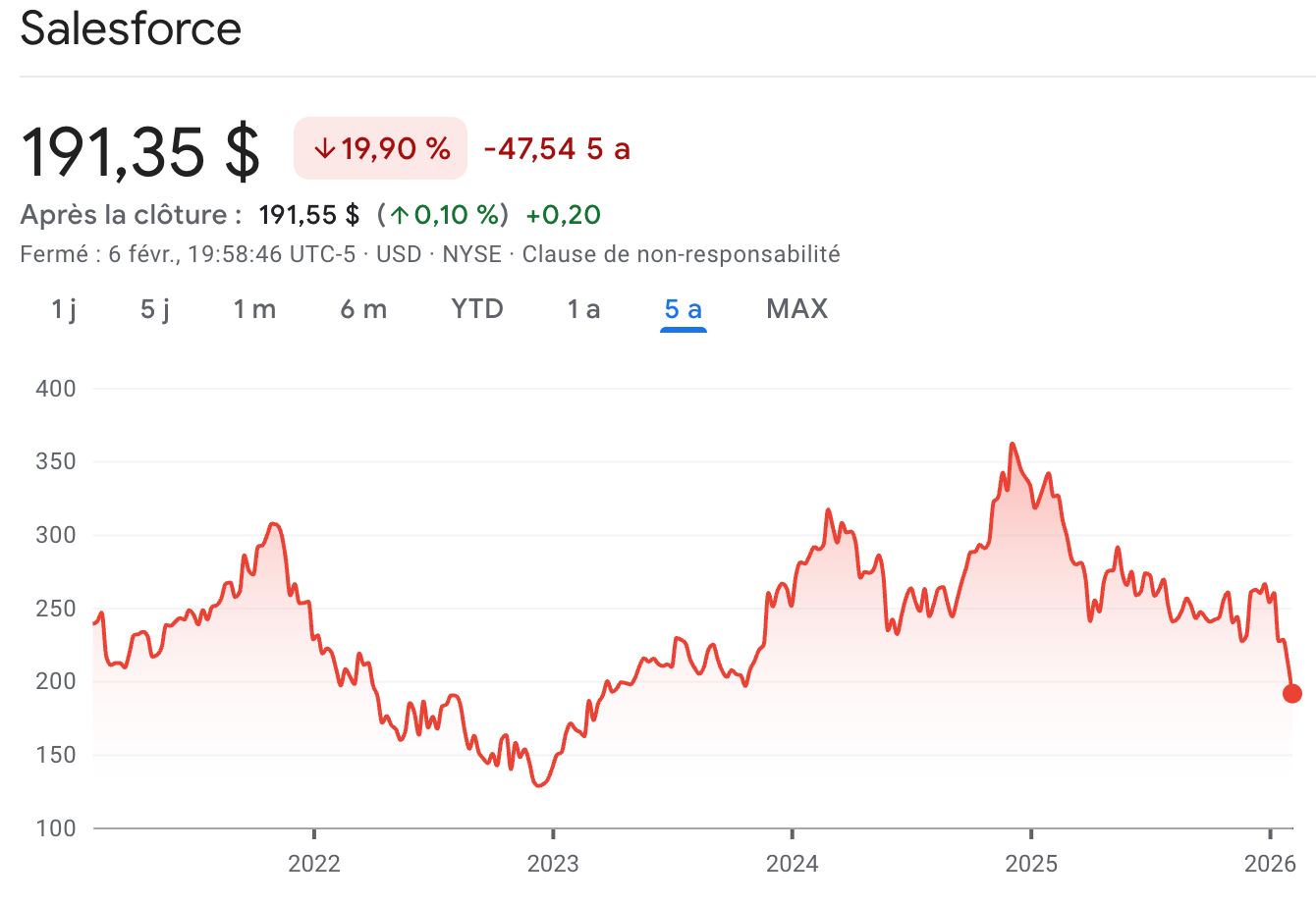
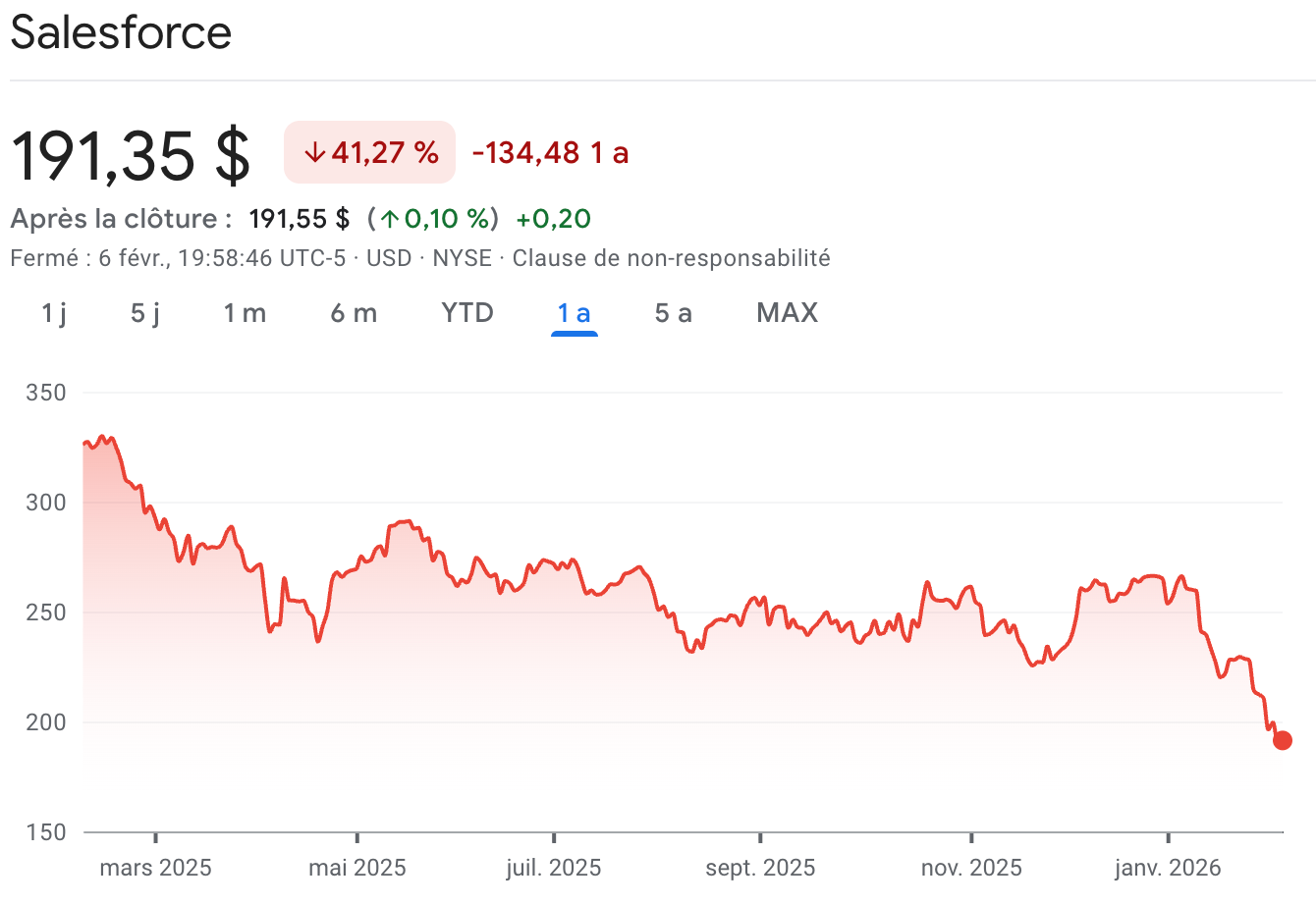
At these levels, it’s really interesting; we are -50% since the highest levels.
The company is still growing revenue years after years. The P/E is still 25,51. Which is a premium we can’t lie.
If I were a Salesforce shareholder, I think I would reinforce my position since the upside can be astronomic; again we are not out of volatility and market’s sentiments can be longer than your patience, that’s why I would advice anyone considering the stock to maybe, start a small position, and see if the narrative shift.
Because yes, currently and in this case, AI is mainly narrative.
If you don’t know me, yet.
At Hidden Market Gems, I start from real-world bottlenecks, not from twitter stock tickers. I don’t have ratios I put into a table to find the next undervalued story (I mean it works well, but instead) I go through critical subjects: infrastructure, energy, materials, sovereignty, compute, Humanity, plumbing that actually breaks.
I trace where systems are under strain, then work backward to find under-followed listed companies that sit exactly at those pressure points (Salesforce is a bad example lol). Small or mid caps, often boring on the surface, but always, always, critical underneath.
The job is simple: translate structural problems into asymmetric equity ideas, before the market notices and we earn the difference. If it resonates with you, you can subscribe.
— Hidden Market Gems.